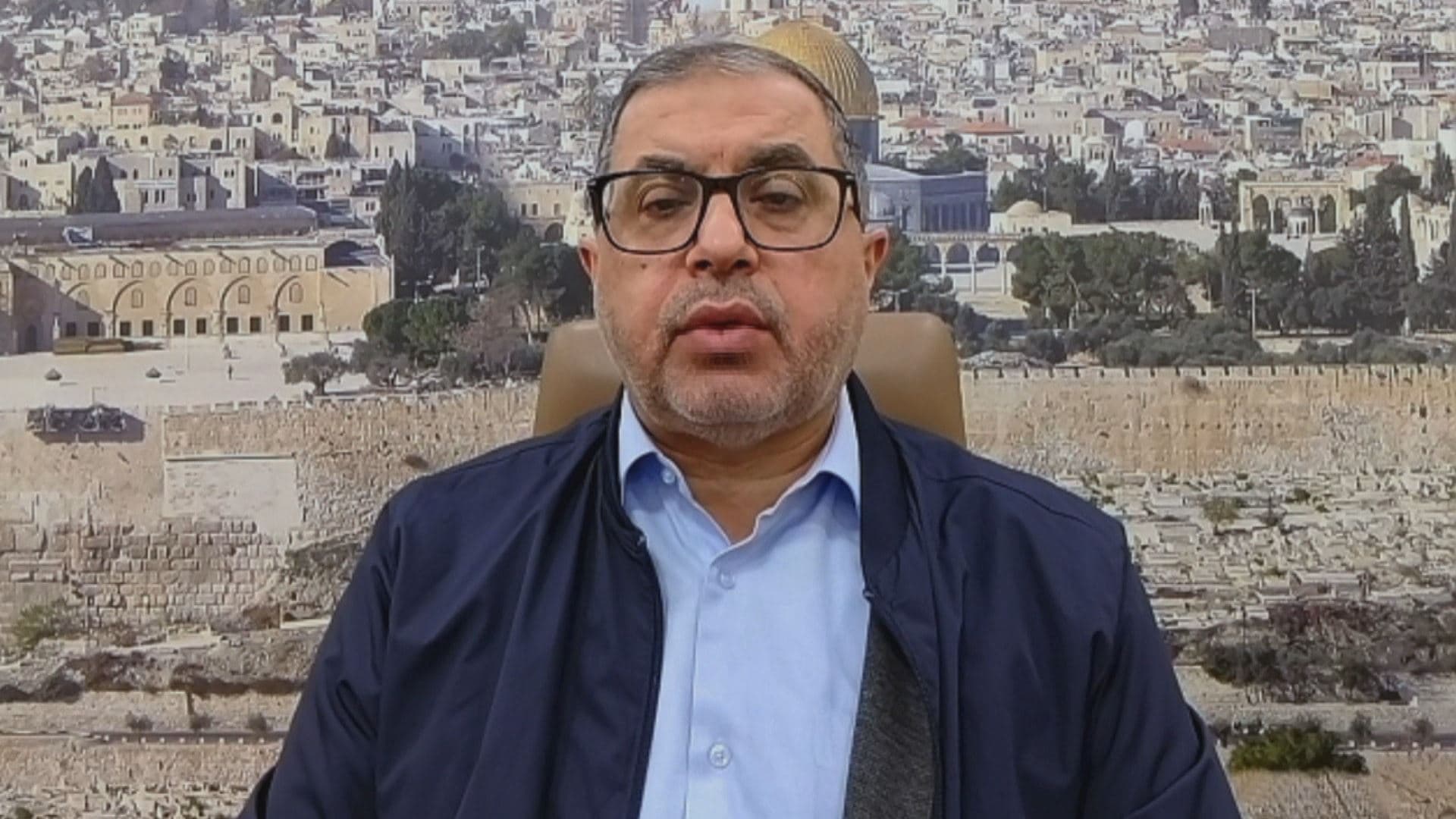

ERBIL, Kurdistan Region - A senior Hamas official revealed that the group has been engaged in direct and indirect talks with American mediators to end the war in Gaza, but blamed the delay on Israeli Prime Minister Benjamin Netanyahu's refusal to accept any Palestinian political presence in Gaza. Basem Naim also stated that while Hamas is willing to relinquish power in the Palestinian enclave, disarmament is non-negotiable.
Engagement with the American side has happened some time ago in order to “reach - or to pressure to reach - a permanent ceasefire,” Naim noted, adding that the United States is “the power capable of exert real pressure” on Israel “to reach a ceasefire."
He noted that Hamas's conditions for a ceasefire remain a permanent end to hostilities, full Israeli withdrawal from the Palestinian enclave, a halt to the “aggression” on Gaza and open crossings for relief and reconstruction.
Naim underscored his group’s readiness for a prisoner exchange while stressing that the group’s “disarmament” and the expulsion of its leaders are “red lines” that are “unacceptable” and not up for negotiation. The arms of the Palestinian group can only open for discussion “after the establishment of a Palestinian state,” he said.
Addressing reports about proposals to transfer Palestinians to other countries, Naim dismissed them as part of “psychological warfare,” stressing that “the Palestinian people are deeply rooted in their land and firmly reject such ideas.”
On October 7, 2023, Hamas launched a large-scale incursion into southern Israel, killing more than 1,170 people, according to Israeli figures. Israel responded with a massive offensive in Gaza that killed 52,000 people, mostly Palestinian civilians, according to the Gaza health ministry. Some 118,014 have also been wounded.
Following 15 months of war, Israel and Hamas agreed to a ceasefire which went into effect in mid-January. However, on March 18, Israel launched new attacks on Gaza, killing more than 2,300 Palestinians and injuring more than 2500 others, according to the Gaza health ministry. Israel says the offensive aims to secure the return of 59 hostages still held by Hamas.
Last week, Hamas released a 21-year-old Israeli-American citizen Alexander Edan, who was captured on October 7.
Naim told Rudaw that Hamas initially sought Edan’s release as part of a ceasefire deal, but an offer was made through mediators before President Donald Trump’s visit to the region last week. He claimed the Trump administration committed to pressuring Israel to allow urgent aid to Gaza and serious ceasefire talks, but expressed disappointment that these outcomes didn’t materialize.
The following is the transcript of the interview with Basem Naim.
Rudaw: Hamas movement says that it recently held direct talks with the American side regarding stopping the war and another phase of ceasefire, in exchange for some conditions that Hamas is preparing to implement in order to stop the war and see a ceasefire declared. To discuss this further, I will be speaking with Dr. Basem Naim, a senior Hamas figure and member of the movement’s politburo, who is joining us from Doha, thank you.
What is the level of engagement between Hamas movement and the United States, what can you tell us about the details?
Basem Naim: First of all, I would like extend – on my behalf and on the behalf of the Hamas leadership and our Palestinian people as a whole - greetings to the Arab leaders and heads of state who met in the Iraqi capital, Baghdad, to participate in the Arab summit. We would also like to extend to the Iraqi people, with all its components, and to the Iraqi leadership with all its parties and components, greetings from dear Palestine, and wishes for the summit’s success and good fortune.
The engagement with the American side happened some time ago, meaning not recently, weeks ago, both directly and indirectly through mediators. These engagements sometimes happened directly, as was the case with [the US special presidential envoy for hostage affairs] Mr. Adam Boehler several weeks ago, or through other means of communication via messages and such, in order to reach - or to press for - a permanent ceasefire. The engagement with the American side took place considering the US is one of the mediators or those who engage between the Islamic Resistance Movement Hamas, and the rest of the [Palestinian] resistance factions, and the other side, the Zionist enemy [Israel].
How can we reach [a ceasefire, one might as]. Considering that force is what can exert real pressure on the [Israeli] entity, to reach a ceasefire. These engagements, as I said, have been ongoing for several weeks, sometimes directly and sometimes indirectly, sometimes face to face, and sometimes through communications in their various forms.
Where were these direct talks held and at what level were they?
They were basically held with the American delegation tasked with following up on the Gaza war dossier and the prisoners’ exchange, meaning [the White House envoy] Mr. Steve Witkoff and his team, and as I said, it was with this team. We met Mr. Boehler more than once, and communication with Mr. Witkoff occurred more than once in different forms. Sometimes we held face-to-face meetings as was the case with Mr. Boehler.
What can you tell us about these engagements? What were the US’s demands and what is Washington’s position on stopping the war, and what are your conditions for stopping the war?
Our conditions are known and clear. We are ready to negotiate or move forward with any agreement provided that it ultimately leads to stopping the war [in the Gaza Strip], stopping the aggression and the genocide, and the withdrawal of all Israeli forces [from the Palestinian enclave] and the opening of crossings for reconstruction. In this context, the prisoner exchange process can take place. They [Israel] can take all their prisoners and a number of our prisoners in the [Israeli] occupation’s prisons can also be released.
Unfortunately, the US sometimes sends positive messages that this are reasonable and logical and can be built upon, but most of the time, there were other members of the American administration or the negotiations team that would go back and repeat the same broken record or the Israeli narrative, which talks says that a permanent ceasefire cannot be reached except through releasing all Israeli prisoners, disarmament of Hamas, expelling some [of the movement’s] leaders, and Hamas giving up the rule [in Gaza].
And our position, of course, was clear. We first want a permanent ceasefire and the withdrawal of [Israeli] forces [from Gaza], and we are ready to release all the prisoners. And as Hamas, I can say that we are ready to leave power today before tomorrow, and this is what we have expressed over the years. We are not clinging to power, we are a resistance movement not a political party who is thirsty for power. We are a resistance movement born from a people under occupation.
Therefore, Hamas remaining in power is not the issue here, and we our position on that is clear. We accept any Palestinian government, either a national unity government or a technocratic one. We also accepted the Egyptian proposal to form a body or a temporary committee that manages the Gaza Strip until a final Palestinian agreement on the [form of rule in Gaza] is reached. As for Hamas movement as a resistance movement, its existence is linked to the continuation of the [Israeli] occupation.
Hamas has expressed its position clearly: our goal is to end the [Israeli] occupation and establish a Palestinian state, and when this goal is achieved, Hamas can transform into a political party, and the weapons of the resistance can be transferred to the desired Palestinian state and all of our resistance fighters will become part of the future Palestinian army. But for now, at this moment in time, we cannot accept that the weapons of the resistance are part of any negotiations. This latter issue is contingent, as I said, on achieving the great accomplishment, which is the establishment of the Palestinian state and the return of the [Palestinian] refugees.
As for the issue of expelling the Palestinian leaders, this is of course unacceptable, and much more than a red line [that cannot be crossed]. Palestinians are living in their own land, in their country and homeland, and among their people. Who has the right to ask the Palestinians to exile themselves and to accept their exile to another place? Certainly, the Palestinians have been resisting, sacrificing, and paying hefty prices for 76 years in order to take root in their land and remain there. Therefore the departure or expulsion of any Palestinian, whether a leader in Hamas or a member of [its armed wing] the al-Qassam [Brigades] or any other Palestinian citizen, cannot be accepted.
Are you ready to give up rule over Gaza in exchange for stopping the war and the reconstruction of Gaza?
That is exactly what we did in 2014 when we handed over power to the government, a national unity government, and we did it in again 2017 when we handed over the administrative committee to the Palestinian government in Ramallah, and in the Beijing agreement in April 2024, which stipulates the presence of all factions, we accepted that the first step towards achieving Palestinian unity is the establishment of a national unity government that represents all Palestinians, and is not necessarily linked to any faction.
So, we are indeed ready to give up power and we also accepted the Egyptian proposal to form a body or a temporary committee to manage the affairs of the Gaza Strip, comprising ten to 15 Palestinians who are native to Gaza and who would manage all the affairs of the Strip from A to Z: health, education, endowments, social affairs, security, crossings, and borders etc. until an agreement is reached on a Palestinian government. We accepted all of this, but as I said, [Israeli Prime Minister Benjamin] Netanyahu is clearly saying: I do not want neither Hamas not Fatah [to rule Gaza]. He also does not want any Palestinian political presence on the historical land of Palestine, whether in Gaza or the West Bank.
And this is what they are doing today even with the [Fatah-controlled and Mahmoud Abbas-led] Palestinian National Authority despite its adoption of the approach of negotiations, peace, and dialogue. They [Israeli government] are also talking about the dismantlement of this authority, in its political capacity.
Therefore, yes, we accepted [to give up rule in Gaza], and stand firm in our position, but this is not linked to the continuation of Hamas as a resistance movement and its pursuit of its goal, which is the establishment of an independent Palestinian state.
Your and the American side's efforts come at a time when Israel has launched a new operation in Gaza. Do you believe that the American side will succeed in stopping the war and declaring another ceasefire?
We believe that the Americans are the strongest party that possesses the right cards and tools. If they have the will and make the decision to stop this war [they can], because Israel as an entity cannot ultimately continue this war without Western support, especially from the US. And in this war, over the course of 18 months, there were many junctures where Israel cried out, pleaded for money and weapons, and turned to the US for that support, in addition to the [US] vetoes in the [United Nations’] Security Council, or by cutting the funding to the International Criminal Court [ICC] to force it to backtrack [its legal action against Israeli officials]. Without this [American] support, this [Israeli] government and the state of Israel cannot survive.
Indeed, it wants to, the US can [succeed in stopping the war in Gaza], but at the same time, [Israeli PM] Netanyahu and his extremist government feel that they enjoy immunity and act as a rogue state, as if they are in a jungle, striking here and there without any accountability, observation, or punishment, and not only in Gaza, in the West Bank there is displacement, there is killing, there is demolition of houses, there is the Judization of Jerusalem, and there is the violation of the sanctity of the al-Aqsa Mosque, the same things are also happening in Lebanon, in Syria, in Yemen... The issue is not only in Gaza and related to the Palestinians. There is an [Israeli] party that is intoxicated by its power and by the unlimited international support it enjoys, especially from the US, which has it acting with the logic and per the rules of the jungle, and as a rogue state.
Therefore, it is the responsibility of the international community, which has failed for 76 years to put an end to this tragedy, and to help the Palestinian people achieve their goals of establishing an independent Palestinian state with Jerusalem as its capital and to ensure the return of [Palestinian] refugees. This abysmal failure of the international community is the responsibility of the international community in itself, and it must be not words and statements, but practical measures and steps to end this tragedy.
You recently released an American hostage, Edan Alexander. What did you receive in exchange for that?
The truth is that the request for the release of the American prisoner had been circulating for some time, for about two months, and we had no problem or objection to his release, but what we asked for was that his release be within a deal and within an integrated vision that would ultimately lead to stopping the war in Gaza. These dialogues and negotiations faltered until we reached the moment, days before US President Donald Trump's visit to the region, and there was an offer to release the captured soldier, Edan Alexander – who is an American-Israeli - through mediators and in exchange for President Trump pressuring or forcing Israel to allow aid to enter the Palestinian enclave the next day. This was a big goal for us, our Palestinian people today have been under a complete siege in Gaza for more than 70 days, and people are dying of hunger because of this closure. The second thing were requested is that the US President calls for serious negotiations to reach a permanent ceasefire.
Unfortunately, despite the fact that the real position between the Americans and the Israelis is unclear even at this moment, some say that the Americans coordinated this position with the Israelis, and some say no, there is a real disagreement between the two sides. In the end, regardless of the reasons behind it, what was agreed upon was not achieved. There was neither an immediate entry of aid to the people in the Gaza Strip, nor the announcement of negotiations for a permanent ceasefire.
How many Israeli hostages does Hamas movement currently hold? And what is their situation?
I do not know the exact numbers, but the talk is about approximately fifty, alive and dead. I do not have an exact number. As for their conditions, they are certainly facing conditions similar to those of the Palestinian people. The members of the resistance and the leadership of the resistance [Hamas] are trying to safeguard them as much as possible, but the conditions in the entire Gaza Strip are very dangerous. Whoever does not die from the bombing at night, dies from hunger in the morning, and this situation applies to both our people and to the prisoners.
But here, I must point out something: that most international media and others ask us about these prisoners, their numbers, and their conditions, and the Palestinian people today have more than 15,000 prisoners inside the occupation prisons, men, women, children, minors, and the sick, who are subjected to the harshest types of torment, psychological and physical torture, sexual assault and rape, starvation, sleep deprivation, and others. Every day we hear news of people dying in [Israeli] prisons. There are about three thousand Palestinians from Gaza who were kidnapped from their homes, from hospitals and shelters, men, women, and children, we know nothing about them, no information at all. We do not even know if they are alive or dead. We hear news from human rights organizations about the extent of the suffering there. Imagine, since their arrest months ago in the Sde Teiman detention camp, they are being held completely naked, their hands and feet cuffed, day and night they are in this state, and they are subjected to all this torture, they are without clothes and receive only little food.
Therefore, we hope that light shed on some prisoners [held by Hamas], who are originally soldiers who came to the Gaza Strip to kill Palestinians, will also be met with highlighting and focusing on the extent of the violations around a million Palestinians and more have endured, since 1967 and until now; men, women, and child prisoners in Israeli jails.
Palestinians, unfortunately, as I said, their rights are always diminished, and the focus on their suffering and issues at the international level is rarely a priority for the international community, especially the West.
In the past few days, American media reported that there are talks underway regarding the transfer of a million Palestinians to Libya. Is this true and would you agree to such a scenario?
First of all, this news falls within the framework of psychological warfare and pressure on our Palestinian people, and for leverage in the negotiations. The Palestinian people have now endured 18 months of this [Israeli] aggression and have yet to raise the white flag and surrender. It is not only the resistance that is patient, all opinion polls say that the Palestinian people categorically refuse to leave Gaza.
And I always say this, on May 6, there were around 1.2 million Palestinians in the city of Rafah [southeast of Gaza] when [Israeli PM] Netanyahu decided to enter Rafah. The next day, on May 7, not a single Palestinian moved to the south. We did not see any image of a single Palestinian moving from Rafah towards the Sinai Peninsula for example or towards Egypt, even though it was not difficult for them to do so, even a few thousand of them, to cross the wall and wire. Instead, the 1.2 million moved north, towards Khan Yunis, the central area of the Gaza Strip and to Gaza city, even though they know they are moving towards death, destruction, and hunger. The Palestinian people are rooted and committed to their land, and categorically reject these proposals [to transfer them to other places].
Now there are attempts, pressures, and contacts even from the [Israeli] entity, and also [pressure] from the Americans on some countries, in order to try to have them accept new immigrants, immigrants from Palestine that is, from the Gaza Strip, whether voluntarily or forcibly. But as per what we know, no country has officially agreed to any such proposal. There are daily reports published by the Israeli media about Palestinians who have left the Gaza Strip voluntarily, and we know that those who leave Gaza today, in coordination with the International Red Cross, are either sick children with their caregivers or wounded people with their companions. Some dual nationals are being contacted by embassies, some hold, for example, a Spanish, British, French, Russian, or other passport, and they are being contacted by their second countries’ embassies and urged to leave Gaza, out of fear for their lives or because of the prevalent danger. Some agree, yes, there are limited numbers, in the dozens, and as we said, most of them are sick or wounded, and there are some students who have scholarships, or have moved to other locations to pursue their studies as well, but certainly, the people in general do not want to leave. The Palestinian people have been paying heavy prices over 76 years in order to return to Palestine, not to leave it.
.jpeg&w=3840&q=75)