

ERBIL, Kurdistan Region - The Druze leadership in Syria’s southern Suwayda province has rejected a roadmap backed by Syria, Jordan, and the United States to address the province's crisis following the deadly July violence that killed over 2,000 people, mostly Druze civilians. A Druze legal body dismissed the plan as inconsistent, calling for international accountability and reaffirming the community's right to self-determination.
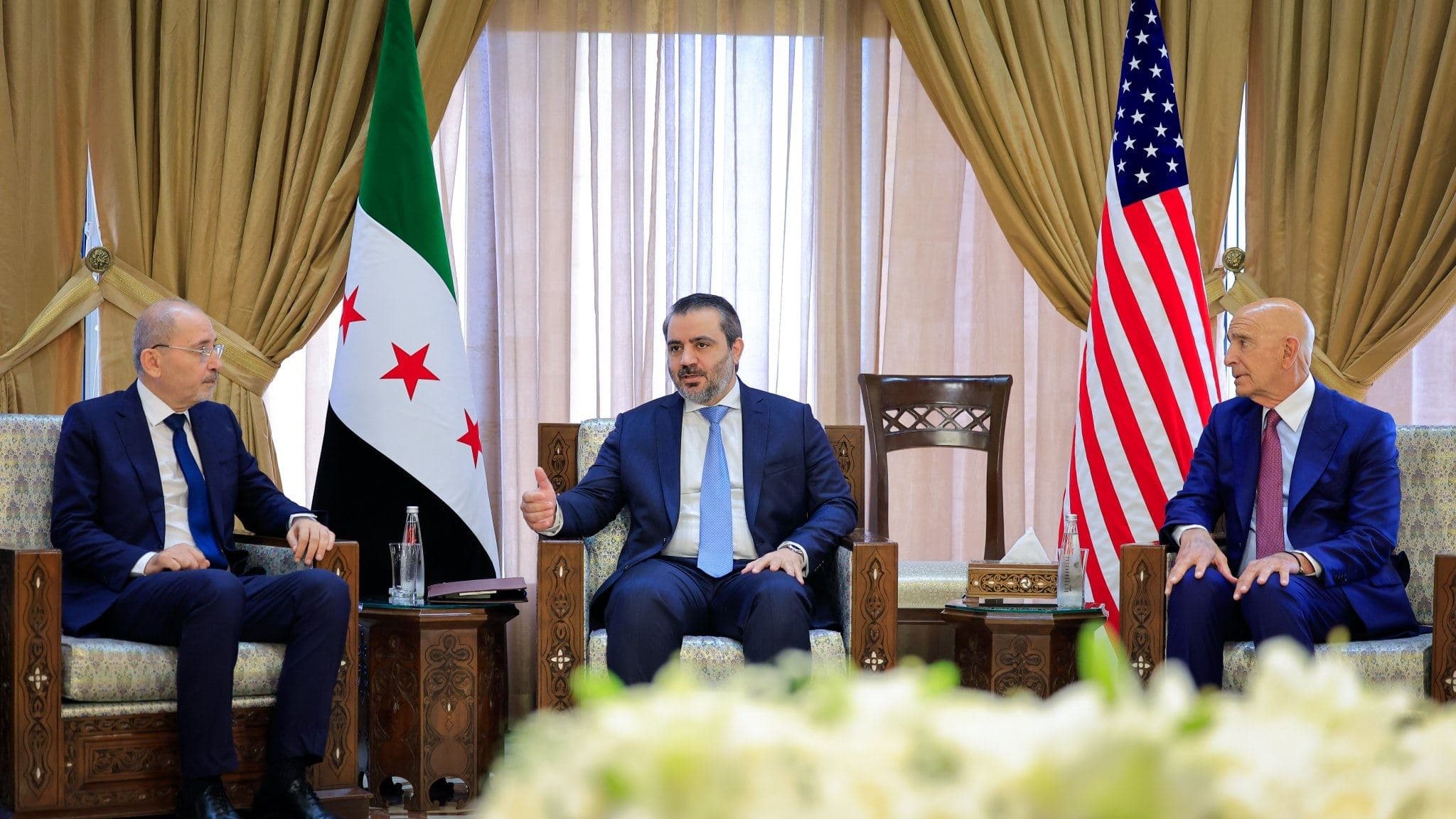
In a statement released late Tuesday on X, the Syrian foreign ministry said that Foreign Minister Asaad al-Shaibani met with his Jordanian counterpart Ayman al-Safadi and the US Special Envoy for Syria Tom Barrack. The trilateral meeting adopted a roadmap for “reconciliation” between the Syrian government and Druze militants governing Suwayda.
The agreement
The three countries “agreed to work together to end the crisis” in the Druze-majority province.
Affirming the unity of Syrian territory and the equal citizenship of all Syrians, including the Druze, they asserted that Suwayda “is an integral part of Syria and has no future outside of it.”
Clashes broke out on July 13 between Druze fighters and Bedouin tribes in Suwayda. The conflict escalated with the involvement of Syrian government forces before a ceasefire was announced by Syrian interim President Ahmed al-Sharaa on July 19.
The UK-based Syrian Observatory for Human Rights (SOHR) on Monday reported that the death toll had reached around 2,047 individuals - 979 of them Druze civilians.
The war monitor added, “817 Druze citizens, including 77 women and 15 children, were field-executed by members from the defense and interior ministries.”
Damascus commitments
According to the Tuesday statement, Damascus has invited the International Independent Commission of Inquiry on the Syrian Arab Republic to probe “the unfortunate events” in Suwayda, vowing to “hold all perpetrators of violations in those events accountable, in accordance with Syrian law.”
The Syrian government will further deploy interior and defense ministry forces along the Suwayda-Damascus road, “withdraw all civilian combatants from the administrative borders” of Suwayda.
A local police force, “comprising all communities in the province,” will also be formed and would be commanded by a figure from Suwayda appointed by the interior ministry, the Tuesday statement read, adding that “negotiations will determine the composition and formation of this force.”
The roadmap further notes that “all civil administrative institutions” in Suwayda would be activated in cooperation between the local community and the relevant state institutions.
A provincial council that represents all components of the local community in Suwayda would also be formed to “interact with the Syrian government and lead efforts aimed at achieving national reconciliation.”
Damascus further vowed to continue the “delivery of sufficient quantities of humanitarian and medical aid” to Suwayda and will “take all necessary steps” to enable the return of its displaced residents.
Tripartite pledges
Syria, Jordan and the US vowed to support international efforts to “complete the release of all detainees and abductees” captured during the July violence.
The three countries will further “work to promote an inclusive, Syrian-led political process” that rebuilds institutions and “ensures the representation of all Syrians.” Amman and Washington pledged to support Damascus in “overcoming the challenges facing this process, including in the areas of reconstruction, institution-building, combating terrorism and extremism, and ending societal disputes and achieving national reconciliation.”
During the Suwayda violence, Israel in mid-July conducted airstrikes targeting Syrian military and government sites, including on a Syrian defense ministry building in Damascus.
While Tel Aviv’s stated reason for the strikes was to protect the Druze community, its intervention is widely believed to have been driven by its aim to maintain a demilitarized buffer zone in southern Syria near its borders.
The Tuesday statement by the Syrian foreign ministry noted that the US “will work to reach security understandings with Israel regarding southern Syria that address the legitimate security concerns of both Syria and Israel, while affirming Syria's sovereignty and territorial integrity.” The roadmap further pledged to “end foreign interference” in Suwayda.
In a Wednesday statement on X, the US Special Envoy for Syria, Barrack, remarked that the Suwayda roadmap charts “a process of healing” and “a path future generations of Syrians can walk as they build a nation of equal rights and shared obligations.”
“Reconciliation begins with a single step,” the senior American diplomat underlined.
Druze reaction
In the aftermath of the deadly events in Suwayda, a committee was formed in the southern province in early August by order of Hikmat al-Hajari - the preeminent spiritual leader of Syria's Druze community.
Named the Supreme Legal Committee and comprising six judges and four lawyers, the body was tasked with managing security and services in Suwayda following the July 19 withdrawal of government forces from the province.
In a statement posted early Wednesday on its official Facebook page, the Committee “completely rejected” the roadmap and its reference to the July events as “unfortunate events” rather than “crimes against humanity.”
The Committee censured what it said was a “blatant contradiction” in the Syrian government’s inviting the Independent International Commission of Inquiry on Syria to probe the events in Suwayda, “yet it later confirmed that accountability would be based on Syrian law.”
“International justice is based on independence and impartiality. We cannot accept its reduction to local channels that have long lost legitimacy and public trust,” the statement read.
The Committee further claimed that the statement “attempts to portray the Syrian government as a neutral party seeking reconciliation,” while “the government and its security and military apparatus were direct partners in the massacres and violations” committed in Suwayda.
The body expressed a “lack of trust” in the Syrian judicial system, calling it “politicized and subordinate to the executive authority,” led by Sharaa. “Any talk of accountability through Syrian law is nothing more than a formal facade to whitewash crimes,” it added.
Of note, Sharaa in mid-March approved a constitutional declaration that granted him exclusive executive power during the country’s five-year transitional period. The declaration added that “no authority will be able to dismiss or isolate another” and that the country’s legislature does not have “the authority to question the president.” Instead, the president can only be held accountable by a constitutional court, which he was granted the “right to assign the judges of.”
The interim constitution has since its passage sparked sharp criticism from Syrian communities, including the Druze, Kurds and others.
The Supreme Legal Committee in Suwayda on Wednesday further censured what it said were attempts to “impose new guardianship” through the establishment of “local councils and joint police forces.”
It reaffirmed the Druze community’s “right to self-determination” arguing that “the crimes committed in Suwayda, and the preceding decades of marginalization, deprivation, and exclusion, constitute valid reasons for demanding the right to self-determination.”
“The people of Suwayda have the legal and moral right to determine their fate freely and independently, whether through self-administration or separation - as the last available option to ensure their security, dignity, and existence,” the Committee stressed.
It is worth noting that in mid-August members of the Druze community took to the streets of Suwayda calling for self-determination, with some waving Israeli flags and chanting slogans in support of joining Israel.
The Committee concluded by urging the international community to reject the roadmap and “any arrangement forcibly imposed on the people of Suwayda.”
.jpeg&w=3840&q=75)
.png&w=3840&q=75)
